
What’s New in Python 3.13: Exciting Features You Need to Know

The latest Python 3.13 release brings several groundbreaking features that aim to improve performance, usability, and the developer experience. Let’s explore three of the most significant updates:
Free-threaded CPython (No GIL)
A Better Interactive Interpreter and Improved Error Messages
Just-in-Time (JIT) Compiler for CPython
Lets dive into all of them one by one.
starting with Free-threaded CPython
1. Free-threaded CPython: Python Without the GIL
The Global Interpreter Lock (GIL) has long been a bottleneck in Python’s performance, particularly for multi-threaded, CPU-bound tasks. In Python 3.13, CPython introduces experimental support for running in a free-threaded mode, which allows threads to execute in true parallel across multiple CPU cores by disabling the GIL.
What Is the GIL?
The GIL is a mutex (mutual exclusion lock) that ensures only one thread runs Python bytecode at a time, even in multi-threaded programs. This prevents race conditions when accessing Python objects but limits parallelism for CPU-intensive tasks.
How to Use Free-threaded Mode in CPython
Get the Free-threaded Build: Download pre-built free-threaded binaries (e.g.,
python3.13torpython3.13t.exe) from the official Python 3.13 installers or build CPython from source with the--disable-gilflag.Verify Free-threading Support: Use
python -VV. If free-threading is supported, the output will include:Enable or Disable the GIL at Runtime:
Use the environment variable
PYTHON_GIL=0to disable the GIL.Alternatively, use the command-line option
-X gil=0.
Example program that utilizes no GIL by performing CPU-bound task:
import threading
import time
import sys

def cpu_bound_task():
    total = 0
    for i in range(10**7):
        total += i
    return total

threads = [threading.Thread(target=cpu_bound_task) for _ in range(4)]

start = time.time()
for t in threads:
    t.start()
for t in threads:
    t.join()
print(f"Time taken with GIL {'ON' if sys._is_gil_enabled() else 'OFF'}:", time.time() - start)
Limitations
The free-threaded mode is still experimental, and some bugs are expected.
Single-threaded programs experience a performance hit due to the removal of GIL optimizations.
C extensions must explicitly support free-threading using the new
Py_mod_gilslot or thePyUnstable_Module_SetGIL()function.
2. A Better Interactive Interpreter and Improved Error Messages
Python 3.13 greatly improves the interactive interpreter (REPL) and makes error messages more informative and user-friendly.
REPL Improvements
The interactive interpreter now offers several usability features:
Multiline Editing: Edit multi-line code while preserving history.
Enhanced Command Support: Run commands like
help,exit, andquitdirectly, without calling them as functions.Colored Prompts and Tracebacks: Enable color by default, making prompts and errors easier to read.
Interactive Help with F1: Browse help documentation interactively.
Better History Browsing with F2: Navigate history while skipping output, as well as the
>>>and...prompts.Paste Mode with F3: Toggle paste mode to handle larger blocks of pasted code.
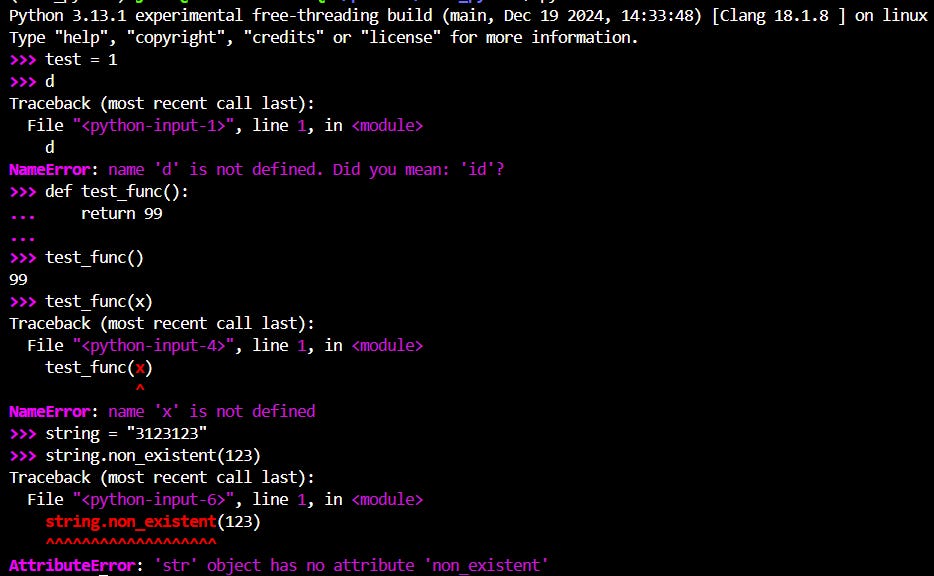
Improved Error Messages
Error messages now provide more actionable information:
Keyword Argument Suggestions: When you pass an incorrect keyword argument to a function, Python suggests the correct one.
Better Import Errors: When an import fails, Python provides more detailed explanations and suggestions to resolve the issue.
3. Just-in-Time (JIT) Compiler for CPython
Python 3.13 introduces an experimental Just-in-Time (JIT) compiler, which dynamically translates Python code into native machine code for faster execution. The JIT compiler builds on the Tiered Execution Model, significantly improving performance for hot code paths.
How the JIT Works
Tier 1: Specialized Bytecode: Python compiles source code into bytecode optimized for faster interpretation.
Tier 2: Intermediate Representation (IR): Frequently executed (“hot”) bytecode is translated into an internal representation called Tier 2 IR (or micro-ops).
Machine Code Generation: Optimized Tier 2 IR is translated into native machine code, which the CPU executes directly.
Copy-and-Patch Optimization: The JIT uses an efficient mechanism called "copy-and-patch" to minimize overhead.
Using the JIT
To enable JIT, build CPython with the --enable-experimental-jit flag:
--enable-experimental-jit=yes: Enables the JIT (default when the flag is set).--enable-experimental-jit=no: Disables the JIT.--enable-experimental-jit=interpreter: Enables Tier 2 optimizations but disables machine code generation.
At runtime, control the JIT with the PYTHON_JIT environment variable:
PYTHON_JIT=1to enable the JIT.PYTHON_JIT=0to disable it.
Conclusion
Python 3.13 is a game-changer for developers, introducing:
True parallelism with free-threaded CPython (no GIL).
Enhanced interactivity with a better REPL and error messages.
Significant performance boosts with the experimental JIT compiler.
While some of these features are still experimental, they pave the way for a faster and more capable Python ecosystem.